Watchtower: A New Tool For Exposing Greenwashing In Finance
2025-03-21 by Zak GottliebAt Bank.Green, our mission is simple yet ambitious: shift banks away from financing fossil fuels by empowering customers to advocate for meaningful, sustainable change. We believe transparency is a powerful force. When people understand their banks' true climate impacts, they can demand accountability and push for greener financial practices.
Over the past few years, Bank.Green has successfully built a reputation for clear, accessible ratings on banks' climate performance. To date, we've rated over 800 banks across the UK, US, Canada, Australia, and Ireland. These ratings, available on our platform, have already empowered over 500,000 bank customers to assess the climate responsibility of their banks, redirecting over £40 million toward greener alternatives.
Yet, as we engaged deeply with bank policies and actual financing practices, we identified a worrying trend: many banks pledged publicly to support sustainability but continued quietly funding fossil fuel projects. This contradiction, known as greenwashing, undermines genuine climate action and leaves customers feeling misled. How could customers and stakeholders hold banks accountable if policies remain opaque and contradictory?
This challenge led to our development of Watchtower. With generous support from our funders, Bank.Green is developing Watchtower from an early prototype into a full dashboard designed to hold financial institutions to account by comparing what they say with what they finance.
How Watchtower Works
Watchtower simplifies and analyses complex banking policies, cross-referencing them against actual financing data. When discrepancies emerge—such as a bank funding a coal project despite a public pledge to phase out fossil fuel investments—the tool flags these as potential breaches of policy
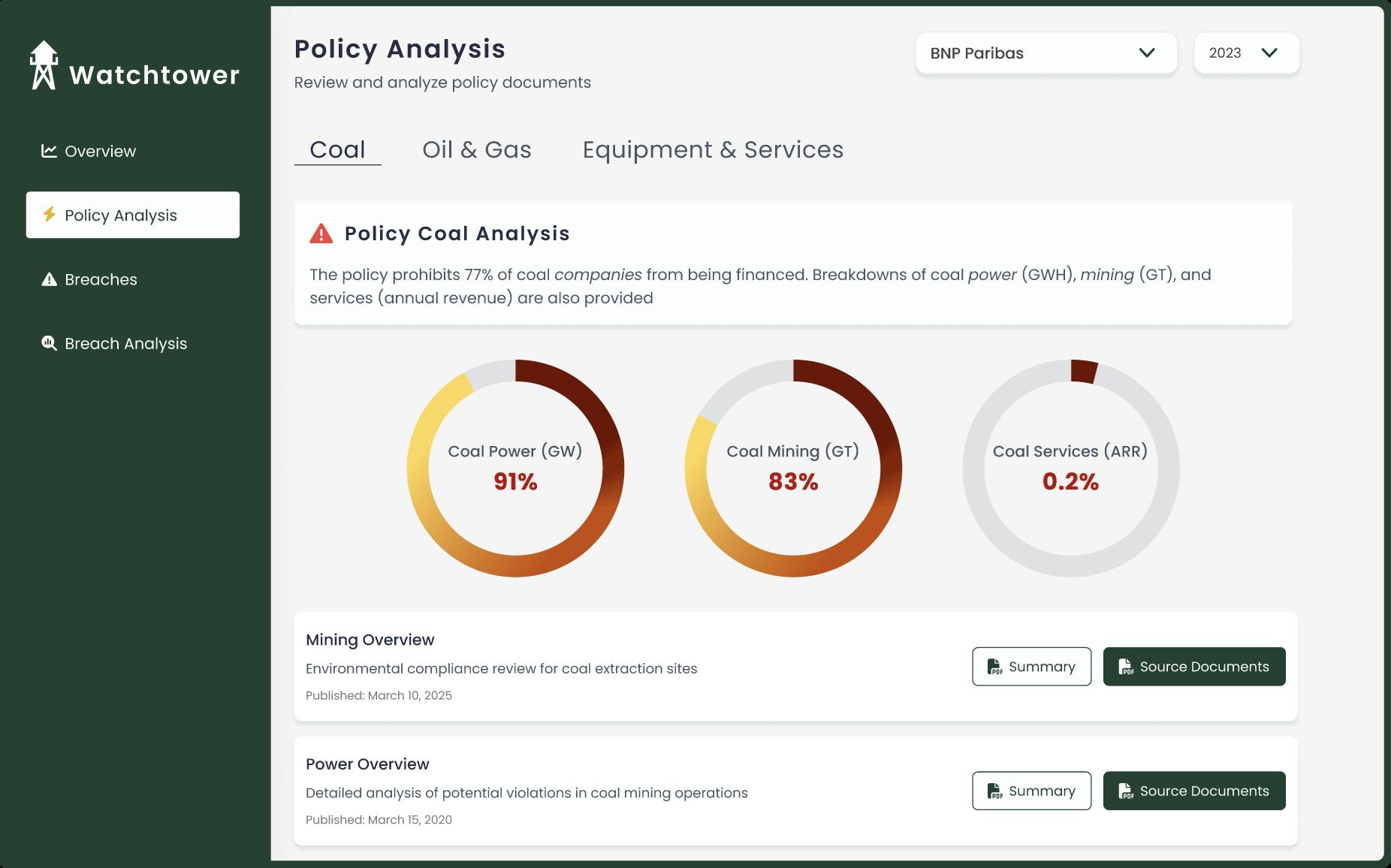
Watchtower simplifies policy analysis.
For example, if a bank publicly commits to excluding clients expanding coal, oil, or gas production, Watchtower can examine whether companies receiving financing are involved in such expansion. Where financing appears inconsistent with a bank’s stated commitments, these cases are flagged and summarised, with links back to the underlying policy language and data sources. This evidence can then be used by climate NGOs, journalists, campaigners, and regulators.
The Data Behind Watchtower
Watchtower’s outputs are only as reliable as the data that underpins them. The tool incorporates real world financing information from authoritative sources including the Banking on Climate Chaos report, alongside datasets provided by partners such as Urgewald. Together, these sources enable Watchtower to surface potential misalignment between banks’ public commitments and their financing activity.
We are currently expanding Watchtower to cover the major global banks assessed in Banking on Climate Chaos, while strengthening the policy analysis that makes these comparisons meaningful.
Deepening Policy Analysis
Identifying potential breaches is only one part of accountability. To understand whether banks are genuinely aligning with their commitments, analysts also need to interpret policies, identify loopholes, and track how commitments change over time. This is now the central focus of Watchtower’s development.
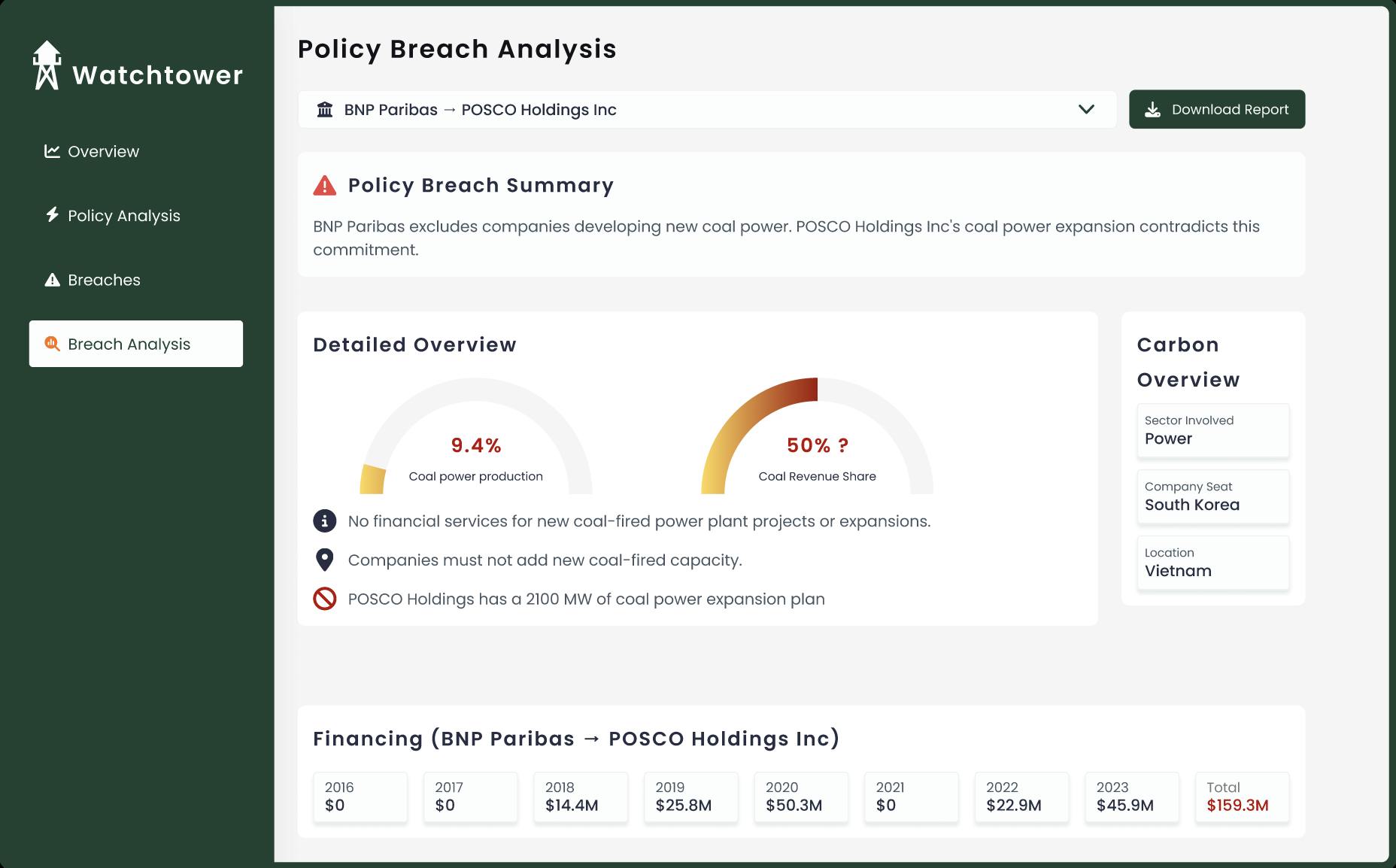
Detailed summary of a potential policy breach.
A central archive of bank policies
Bank policies are often scattered across websites, updated without notice, and difficult to locate after the fact. Watchtower is being developed into a dedicated policy archive that allows analysts and campaigners to reliably access both the most recent versions of banks’ relevant climate and sector policies and historical versions preserved over time.
By maintaining a structured repository of policy documents, Watchtower reduces the risk of analysts relying on outdated information and removes the need for repeated, manual policy hunting.
Making loopholes and patterns visible
Bank policies are long, technical, and frequently ambiguous. Watchtower is being built to help users analyse policies more efficiently by bringing related themes together across a bank’s documents. This makes it easier to see how commitments interact, where definitions create ambiguity, and where exclusions are weakened by exceptions, thresholds, or carve outs.
This thematic approach also supports clearer comparisons between banks, allowing analysts to identify differences in policy strength without days of manual reading.
Tracking backsliding and strengthening over time
One of the most important accountability questions is whether banks’ commitments are strengthening or weakening. Watchtower is being developed to support systematic comparison of policy versions over time, making it possible to see how commitments evolve.
This includes identifying when exclusions are narrowed or delayed, when binding language is softened, and when new exceptions are introduced. By preserving historical policies and surfacing changes clearly, Watchtower helps users ground claims of progress or backsliding in evidence.
A step forward in tackling greenwashing
Transparency and accountability remain essential tools in addressing the climate crisis. Watchtower is designed to bridge the gap between policy promises and financing reality, while also making bank policies easier to find, interpret, and compare over time.
With continued support from our funders and partners, Bank.Green is building Watchtower into a practical, evidence led dashboard for climate finance accountability, designed for the people doing the work: policy analysts, campaigners, journalists, and oversight bodies.
Start to Bank Green Today
Banks live and die on their reputations. Mass movements of money to fossil-free competitors puts those reputations at grave risk. By moving your money to a sustainable financial institution, you will:

Send a message to your bank that it must defund fossil fuels
Join a fast-growing movement of consumers standing up for their future
Take a critical climate action with profound effects